AI Decoder initialized. Ready for co-adaptation.

--- Starting BCI Simulation ---
User intends to move cursor from [0. 0.] to [10. 10.]
Step 0: Cursor at [0.96 0.55]
Step 10: Cursor at [8.14 3.34]
[1768608891] Decoder adapted with 20 recent examples.
Step 20: Cursor at [17.43 12.83]
[1768608891] Decoder adapted with 30 recent examples.
Step 30: Cursor at [-2.01646284e+07  2.52741930e+08]
[1768608891] Decoder adapted with 40 recent examples.
Step 40: Cursor at [ 3.58500395e+26 -1.51733802e+27]
[1768608891] Decoder adapted with 50 recent examples.
--- Simulation Finished ---
Final cursor position: [ 3.33231242e+26 -1.41038739e+27]30 Brain-Computer Interfaces: The New Frontier of Human-AI Interaction
NoteLearning Objectives
By the end of this chapter, you will be able to:
- Understand the fundamental principles of Brain-Computer Interfaces (BCIs) and their transformative potential.
- Compare the major categories of BCI technology: non-invasive, semi-invasive, and invasive.
- Appreciate the critical role of AI and machine learning in decoding complex neural signals.
- Analyze the clinical applications of BCIs for restoring function in patients with paralysis, ALS, and other neurological conditions.
- Envision the future of human-AI collaboration enabled by high-bandwidth neural interfaces.
30.1 20.1 Introduction: The Ultimate Interface
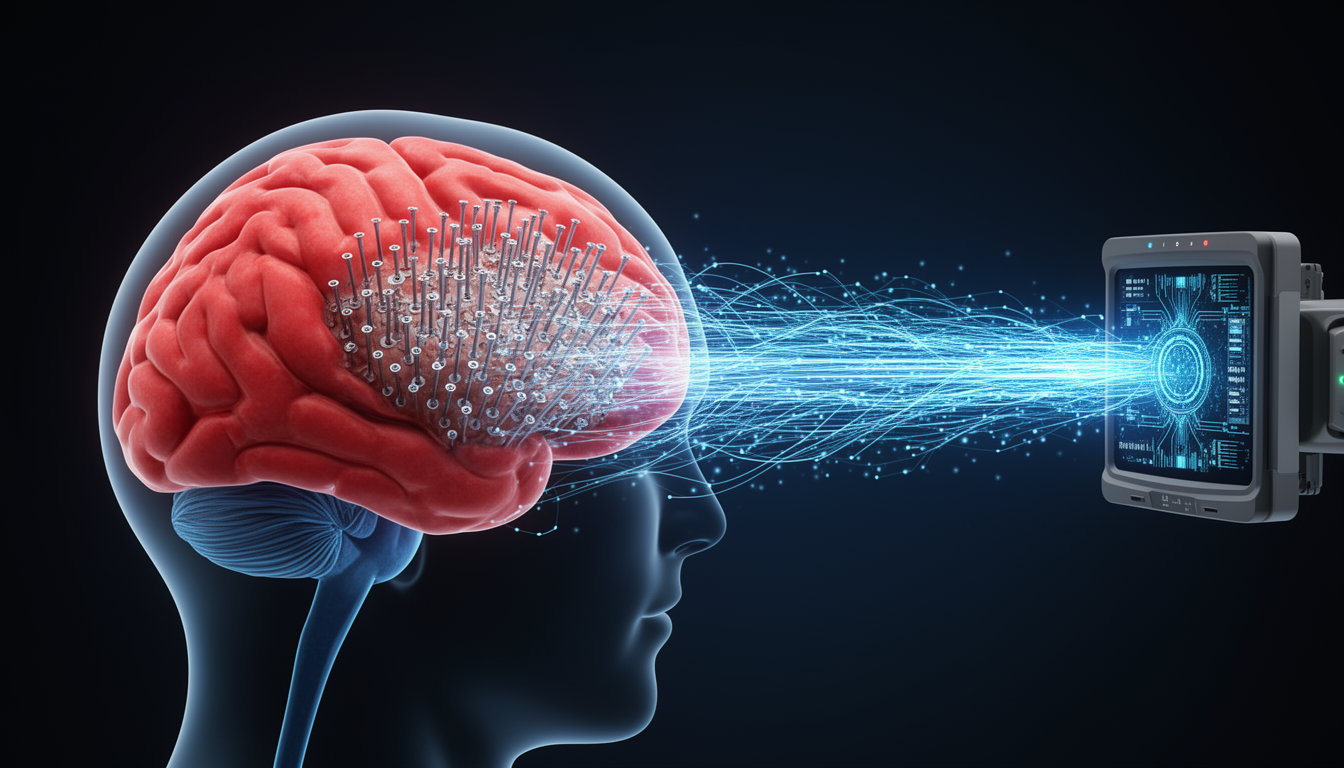
For decades, we have communicated with machines through the clumsy intermediaries of keyboards, mice, and touchscreens. We translate our thoughts into muscle movements, which then manipulate a device to translate the action back into a command. A Brain-Computer Interface (BCI) short-circuits this entire process. It creates a direct pathway from the brain to an external device, translating the raw language of the mind—the electrical firing of neurons—into action.
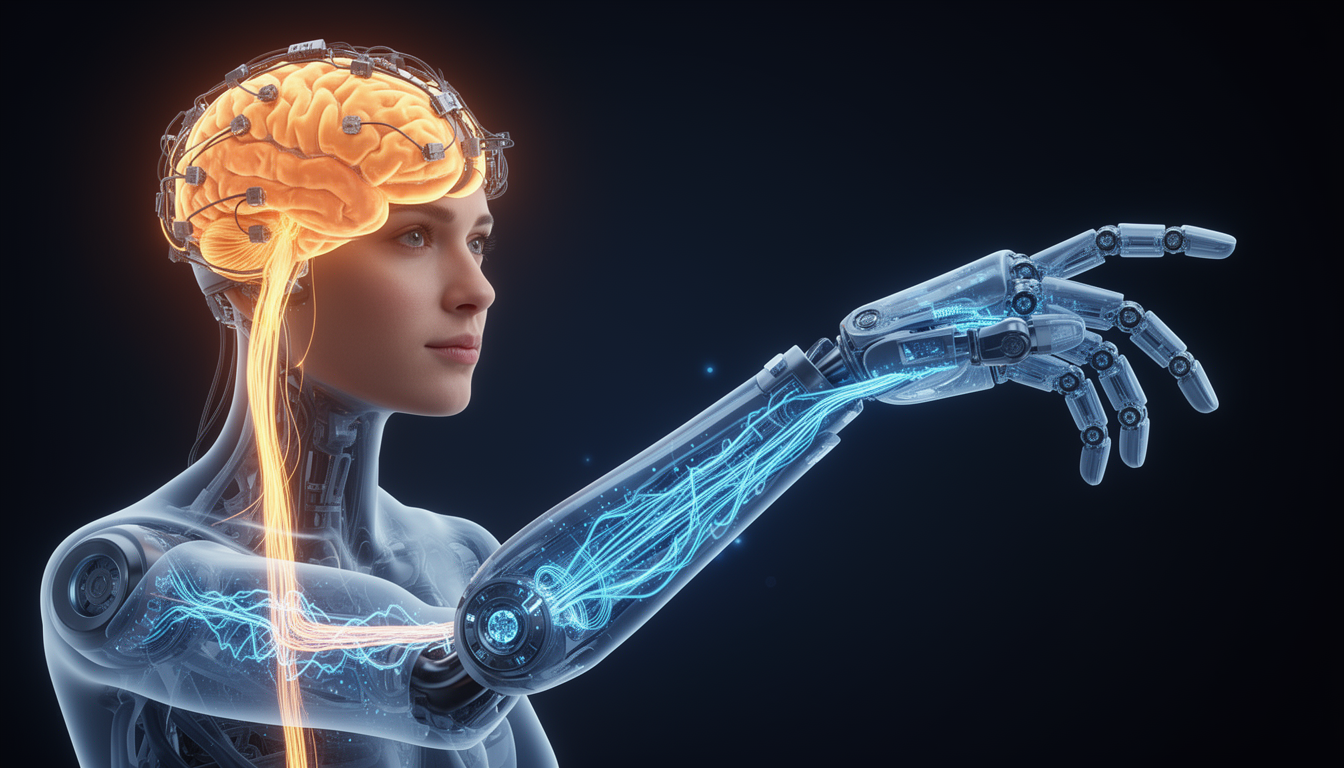
This is not science fiction. For a person with paralysis from a stroke or ALS, a BCI can be a life-altering connection to the world, allowing them to type an email to a loved one or move a robotic arm to pick up a cup of water, all by simply thinking about it.
BCIs represent the ultimate frontier of human-AI interaction. They are the point where neuroscience and artificial intelligence converge to create a truly symbiotic relationship between mind and machine. This chapter explores the technology that makes this possible, the AI that unlocks its power, and the future it promises.
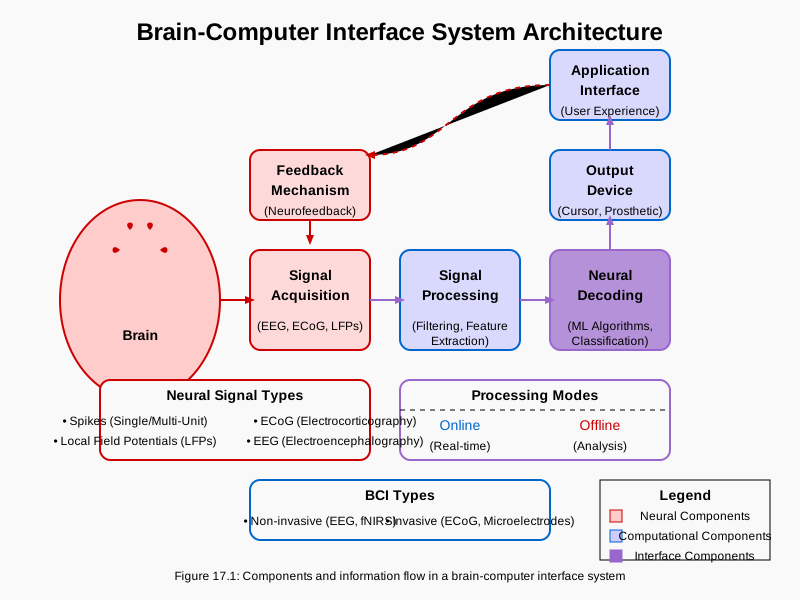 Figure 20.1: The core components of a BCI system. The system acquires neural signals, which are then preprocessed and decoded by an AI model into commands that control an external device, with feedback sent back to the user.
30.2 20.2 The Language of the Brain: Neural Signals for BCI
To build a BCI, we first need to listen to the brain. We can do this at different levels of detail, which is like choosing between listening to the roar of a crowd outside a stadium versus placing a microphone in front of a single person.
- Electroencephalography (EEG): This is the most common non-invasive method. Electrodes are placed on the scalp to record the summed electrical activity of millions of neurons. It’s like listening from outside the stadium—you can hear the big cheers (like the brain’s alpha waves) but not individual conversations.
- Electrocorticography (ECoG): A semi-invasive method where a grid of electrodes is placed directly on the surface of the brain. This gets inside the stadium, providing a much clearer signal than EEG, with less noise from the skull.
- Microelectrode Arrays: These are invasive devices, like the Utah Array, that are implanted directly into the brain tissue. They consist of tiny needles that can record the firing of individual neurons (action potentials or “spikes”). This is like having a microphone for every person in the crowd—it provides the highest-fidelity signal but also carries the most risk.
The choice of method depends on the application, balancing the need for signal quality with the risks of surgery.
30.3 20.3 BCI Technologies: Reading the Mind
BCI systems are defined by how they read these neural signals.
20.3.1 Non-Invasive BCIs: The Brain from the Outside
EEG-based BCIs are the most widely used due to their safety and ease of use. They are often used to detect broad mental states. A common application is the P300 Speller, where a user focuses on a letter in a flashing grid. The brain produces a characteristic electrical signal (the P300 wave) about 300 milliseconds after the desired letter flashes, which the BCI can detect to spell out words. Another approach uses motor imagery, where the user imagines moving their left or right hand, creating distinct EEG patterns over the motor cortex that can be decoded into commands.
20.3.2 Invasive BCIs: The Brain from the Inside
For tasks requiring fine control, like moving a robotic arm, invasive BCIs are necessary. By recording from hundreds of individual neurons in the motor cortex, these systems can decode the rich, complex patterns associated with intended movements.
Pioneering work in this area has allowed individuals with tetraplegia to: - Control a robotic arm with multiple degrees of freedom. - Type on a virtual keyboard at speeds rivaling able-bodied typing. - Regain control of their own paralyzed limbs through a “neural bypass” that routes motor signals from the brain to muscle stimulators.
30.4 20.4 The AI Revolution in BCI
Raw neural data is incredibly complex and noisy. A single second of data from a 100-electrode array can contain tens of thousands of data points. The central challenge of BCI is finding the meaningful signal in this storm of noise. This is where AI, and specifically machine learning, has been revolutionary.
An AI-powered neural decoder is the core of any modern BCI. It is a machine learning model that learns the mapping between patterns of neural activity and the user’s intent.
20.4.1 Decoding with AI
- Early Decoders: Simple linear models, like the Kalman filter, were used to predict movement direction from the firing rates of motor neurons.
- Deep Learning Decoders: More recently, deep learning models like Recurrent Neural Networks (RNNs) and Transformers are being used. Their ability to model complex temporal sequences makes them perfectly suited for interpreting the dynamic, evolving patterns of neural activity. They have significantly improved the speed and precision of BCI control.
20.4.2 Co-Adaptation: A Two-Way Street
The most advanced BCIs rely on co-adaptation, where both the user and the AI decoder learn from each other. 1. The user’s brain learns to produce clearer, more consistent neural patterns that the decoder can easily interpret. This is a form of neurofeedback, where the brain adapts through trial and error. 2. The AI decoder continuously updates its model in real-time, adapting to changes in the user’s brain signals.
This creates a closed-loop system where the human and AI work together, progressively improving the performance of the interface.
30.5 20.5 The Future: High-Bandwidth Human-AI Collaboration
Current BCIs are still relatively low-bandwidth. While life-changing, they transmit information far more slowly than natural speech or movement. The future of BCI research is focused on creating high-bandwidth interfaces that could enable a truly seamless partnership between human and artificial intelligence.
Imagine a future where: - An architect can manipulate a 3D model in a CAD program as fluidly as they can imagine it. - A scientist can explore vast datasets, with an AI assistant intuitively understanding their line of inquiry and pre-fetching relevant information based on their cognitive state. - Communication is no longer limited by the speed of our thumbs on a screen but happens at the speed of thought.
This vision requires breakthroughs in electrode technology, a deeper understanding of the neural code, and even more powerful AI decoders. It also raises profound ethical questions (Chapter 15) about privacy, agency, and identity that we must navigate carefully.
However, the potential is clear: BCIs could be the technology that transforms computers from tools we command into true partners that we collaborate with, directly merging the creative, intuitive power of the human brain with the computational power of AI.
30.6 Exercises
Conceptual Questions
BCI Recording Modalities: Compare and contrast EEG, ECoG, and microelectrode arrays as BCI recording methods. For each, discuss the trade-offs between signal quality, invasiveness, and practical usability. Which method would you choose for (a) a spelling application for a locked-in patient, and (b) controlling a prosthetic arm with fine motor control?
The Neural Code: BCIs must decode the “language” of the brain. Explain what information can be extracted from different neural signals: spike rates, spike timing, local field potentials (LFPs), and EEG oscillations. Why is the choice of signal important for different BCI applications?
Co-Adaptation: Explain the concept of co-adaptation in BCIs, where both the user’s brain and the AI decoder learn from each other. Why is this bidirectional learning important? Provide an analogy to help explain this concept.
High-Bandwidth BCIs: The chapter envisions future “high-bandwidth” brain-computer interfaces. What does “bandwidth” mean in this context? What are the main technical bottlenecks preventing current BCIs from achieving higher bandwidth? Consider factors related to recording technology, decoding algorithms, and our understanding of neural codes.
Computational Problems
- Simple Neural Decoder: Implement a basic linear decoder for a simulated motor BCI:
- Generate synthetic neural data: 50 neurons, 1000 time points, where firing rates are noisy linear functions of intended movement direction (2D)
- Train a linear regression model to predict movement from neural activity
- Test the decoder and calculate prediction accuracy (e.g., correlation between predicted and actual movement)
- Visualize: scatter plot of predicted vs. actual movements, and the decoder weights
- Online Adaptation: Extend the code example from section 20.4 to implement and compare different adaptation strategies:
- No adaptation (static decoder)
- Batch adaptation (retrain every N trials)
- Online adaptation (update continuously with exponential weighting)
- Compare the three approaches by plotting decoder performance over time
- Simulate a “non-stationary” scenario where the neural signal changes (e.g., electrode drift), and show which adaptation strategy is most robust
- P300 Speller Simulation: Implement a simplified P300 speller BCI:
- Simulate a 6x6 letter grid
- Generate synthetic EEG data where the target letter’s row/column flash produces a P300 response (a characteristic waveform ~300ms after stimulus)
- Implement a classifier (e.g., logistic regression or SVM) to detect P300 responses
- Calculate typing speed (characters per minute) and accuracy
- Vary the number of flash sequences per selection and plot the speed-accuracy trade-off
- BCI Performance Metrics: Research and implement key BCI performance metrics:
- Information Transfer Rate (ITR): Calculate bits per minute for a BCI system given accuracy and selection time
- Compare ITR across different BCI paradigms (e.g., P300 speller vs. motor imagery vs. invasive cursor control)
- Plot how ITR changes with accuracy and selection time
- Discuss what ITR values are needed for practical communication
Discussion Questions
Clinical vs. Enhancement BCIs: Most current BCI research focuses on clinical applications (restoring function for people with disabilities). However, there is growing interest in BCIs for “enhancement” in healthy individuals (e.g., faster learning, memory augmentation, direct brain-to-brain communication). Discuss the ethical, social, and practical considerations that distinguish these two use cases. Should they be regulated differently?
The Autonomy Paradox: For individuals with locked-in syndrome, a BCI can restore communication and autonomy. However, BCIs also create new dependencies (on technology, on caregivers to maintain the device) and vulnerabilities (what if the device is hacked or malfunctions?). Discuss this paradox: how can we maximize the autonomy-restoring potential of BCIs while minimizing new forms of dependency and risk?
The Future of Human-AI Collaboration: The chapter envisions BCIs enabling “thought-speed” collaboration between humans and AI. Imagine you have access to such a high-bandwidth BCI that connects your brain directly to an AI assistant. How might this change the nature of work, creativity, and learning? What skills might become more or less valuable? What are the potential risks of becoming too dependent on such an interface?
ImportantChapter Summary
This chapter explored the exciting frontier of Brain-Computer Interfaces, where neuroscience and AI merge to create a direct communication channel between mind and machine.
- The Core Principle: BCIs work by acquiring neural signals, using AI to decode the user’s intent, and translating that intent into action.
- BCI Technologies span a spectrum from non-invasive methods like EEG, which are safe and easy to use, to invasive microelectrode arrays, which provide the highest-fidelity signals for fine motor control.
- The AI Revolution: Modern AI, particularly deep learning, has been the key to unlocking the potential of BCIs by providing powerful neural decoders that can find meaningful patterns in noisy brain data. The most advanced systems use co-adaptation, where both the user’s brain and the AI model learn from each other.
- Human Impact: BCIs are already having a life-changing impact in clinical settings, restoring communication for patients with locked-in syndrome and movement for those with paralysis.
- The Future of Interaction: The ultimate goal is to create high-bandwidth interfaces that could enable a seamless, thought-speed collaboration between humans and AI, fundamentally changing how we interact with technology.
ImportantKnowledge Connections
Looking Back - Chapter 2 (Neurons) & Chapter 4 (Perception): The neural signals that BCIs record—action potentials, LFPs, and EEG waves—are the fundamental biological phenomena we explored in the opening parts of this handbook. - Chapter 11 (Sequence Models): The RNNs and Transformers used to decode the temporal patterns of neural activity are the same architectures used for language modeling.
Looking Forward - Chapter 15 (Ethical AI): BCIs are the technology where the “neurorights” we discussed become most critical. The rights to mental privacy, identity, and agency are central to the responsible development of BCIs. - Chapter 22 (Embodied AI): BCIs provide a powerful pathway for controlling the kinds of robotic and embodied agents we will discuss later.
30.7 References
Ajiboye, A. B., Willett, F. R., Young, D. R., Memberg, W. D., Murphy, B. A., Miller, J. P., … & Kirsch, R. F. (2017). Restoration of reaching and grasping movements through brain-controlled muscle stimulation in a person with tetraplegia: A proof-of-concept demonstration. The Lancet, 389(10081), 1821-1830.
Collinger, J. L., Wodlinger, B., Downey, J. E., Wang, W., Tyler-Kabara, E. C., Weber, D. J., … & Schwartz, A. B. (2013). High-performance neuroprosthetic control by an individual with tetraplegia. The Lancet, 381(9866), 557-564.
Farwell, L. A., & Donchin, E. (1988). Talking off the top of your head: Toward a mental prosthesis utilizing event-related brain potentials. Electroencephalography and Clinical Neurophysiology, 70(6), 510-523.
Georgopoulos, A. P., Schwartz, A. B., & Kettner, R. E. (1986). Neuronal population coding of movement direction. Science, 233(4771), 1416-1419.
Hochberg, L. R., Bacher, D., Jarosiewicz, B., Masse, N. Y., Simeral, J. D., Vogel, J., … & Donoghue, J. P. (2012). Reach and grasp by people with tetraplegia using a neurally controlled robotic arm. Nature, 485(7398), 372-375.
Moxon, K. A., & Foffani, G. (2015). Brain-machine interfaces beyond neuroprosthetics. Neuron, 86(1), 55-67.
Pandarinath, C., O’Shea, D. J., Collins, J., Jozefowicz, R., Stavisky, S. D., Kao, J. C., … & Sussillo, D. (2018). Inferring single-trial neural population dynamics using sequential auto-encoders. Nature Methods, 15(10), 805-815.
Vansteensel, M. J., Pels, E. G., Bleichner, M. G., Branco, M. P., Denison, T., Freudenburg, Z. V., … & Ramsey, N. F. (2016). Fully implanted brain-computer interface in a locked-in patient with ALS. New England Journal of Medicine, 375(21), 2060-2066.
Willett, F. R., Avansino, D. T., Hochberg, L. R., Henderson, J. M., & Shenoy, K. V. (2021). High-performance brain-to-text communication via handwriting. Nature, 593(7858), 249-254.
Wolpaw, J. R., Birbaumer, N., McFarland, D. J., Pfurtscheller, G., & Vaughan, T. M. (2002). Brain-computer interfaces for communication and control. Clinical Neurophysiology, 113(6), 767-791.